 |
| Brigitte Bardot sunbathing topless, c. 1960. |
Wednesday, October 3, 2012

Ed Cooke: On the Memory Palace
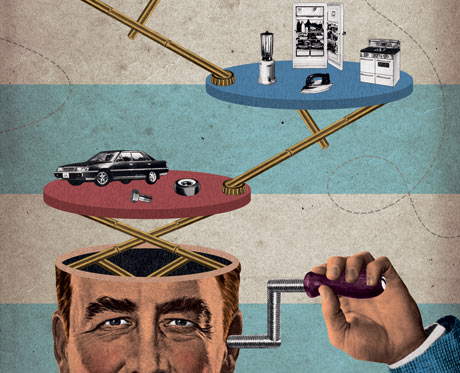
iIlustration: Randy Mora/YCN
Have you ever wondered how some people manage to learn multiple decks of cards in perfect sequence, list thousands of items, or recall vast tracts of poetry? These feats are so foreign to our sense of what our memory is normally capable of that we often assume that some kind of special brainpower is the only way to account for them.
In almost all such cases, though, a remarkably simple technique can take the credit. Memory palaces are said to be the brainchild of a man named Simonides, who famously nipped out of a banquet at the moment the hall happened to collapse, killing the guests inside. His luck was twofold: not only did he survive, but he realised he could recall the exact location of the less fortunate dinner guests, and thereby identify their otherwise unrecognisable remains.
After Simonides, the Greeks came to understand that our most robust and powerful memory is for spaces and what happens in them. We learn their structure and contents effortlessly, absorbing hundreds of "facts" without even noticing it. Whenever we conjure up a memory, one of the first things we recall is where the event took place. This is most likely a legacy of our mammalian ancestors, who had plenty of practice at locating familiar sources of food and shelter.
The Greeks' innovation was to co-opt these powerful spatial and visual systems into the service of learning more abstract information. They practiced transforming lists of words into colorful sets of objects, which they arranged in their imagination around familiar spaces. Then they learned to automatically translate these images back to their original meaning.
How to create your own memory palace
Let's explore how this works by attempting to learn 40 of Shakespeare's plays in chronological order (see PDF below). This may sound like a daunting task, but if you follow these six steps, you should be able to do it.
• First, think of a familiar route. The path from your bedroom to the local shop, for example, via the rest of your house. The first stop might be your bed, the second your wardrobe, then your doorway or bathroom. Don't be afraid to pass through walls. Try and imagine a 40-stop route in total.
• Think of an image to correspond with each play. As we know, vivid images are marvellous for memory. Imagine The Two Gentlemen of Verona as two men in bowler hats wrestling, for instance; The Taming of the Shrew could be a vicious shrew being tamed; King Henry VI parts 2, 3 and 1 might be Prince Harry, aged six, trying to count to three, and instead counting 2, 3, 1... You get the picture. Remember, always go with your own personal associations – not necessarily the examples given here. We've left a column on the PDF for you to fill in with your own vivid images.
• Imagine walking along the route, linking the images and locations together in your mind. The two gentlemen might be wrestling on your bed, for example; the shrew might be in your wardrobe; a six-year-old Prince Harry could be standing at your bedroom door, and so on. Continue in this way until each play has found a place in the sequence. Try to feel the emotion you would experience if these scenes were actually taking place in your house: disgust, elation, suspicion, surprise. This will help etch the images into your memory.
• Practise recalling the plays in order. After a couple of walk-throughs, in which you practise recalling the images in the correct order, you're ready to recite the plays of Shakespeare in chronological order. Close your eyes, go along the route and translate each image into the correct play as you encounter it. Sometimes, you might find that you can't remember what the image stands for. Don't worry about that, just make a mental note and try again. It'll soon become automatic.
• Practise recalling the plays backwards. One of the great advantages of spatial memory is how flexible it is. You should be able to list the plays backwards as well as forwards. Also, try challenging yourself by asking: "What comes before Cymbeline? What comes after?" (This is also a good way to while away time on the commute to work.)
With this method, it's possible to learn lists that are thousands of items long. Spatial memory is extraordinarily capacious in this way: if you are willing to spend the time arranging a thousand images in your mind, you'll be able to learn a thousand item list. Imagine that!
Shakespeare plays
The ‘Amygdala Hijack’
"When a man lies down on the psychoanalyst’s couch, a horse and an alligator lie down with him." -- Arthur Koestler

In 1970, the neurologist Paul MacLean proposed a three-part structure to the brain, reflecting different stages in our evolution.
The brainstem or ‘reptile brain’
The ‘reptile brain’ processes anger, fear, and the territorial instinct. These basic emotions provide a ‘quick and dirty’ way for primitive animals to ‘decide’ to move away from danger, and towards what they wanted (such as food), as well as to protect their territory. These ‘fight or flight’ responses can motivate us to extraordinary efforts in time of need – but they also need to be kept under control, or they can lead us to do things we might regret later.The limbic system or ‘mammalian brain’
As we move up the evolutionary scale, we see an expansion in the limbic system. These structures enable more complex emotions such as ‘caring’ which provide motivation for animals and birds to nurture their young. Animals that live in complex social groups also need a way of ‘reading’ the emotional state and likely behavior of each other group member – the limbic system provides that ability in a fairly reliable way.The cerebral cortex or ‘reasoning brain’
At the human level, our language and reframing abilities allow us to experience more shades and nuances of emotion, tremendously expanding our emotional palette. We can have ‘thoughts about our feelings’; we can use language to motivate others by inspiring emotions in them; and, crucially, most of the time we can reframe our raw emotional impulses to get them under control and put things into perspective.Stress and the triune brain
Although we are capable of reason and emotional control, we don’t operate in this mode all the time. Under stress or the influence of alcohol or other drugs, it is all too easy to regress right back down to the ‘reptile brain’ level. Common examples would include road rage, territorial disputes between neighbours and barroom brawls.Criticisms of the triune brain model
The triune brain model is a mainstay of Accelerated Learning, which is where you are most likely to come across it. More recent neuroscientists have criticized the model as being too simplistic. We have included it here for completeness, but although it should not be taken too literally, it remains a useful metaphor for how reason and logic can break down under stress.Recognising emotions – left and right brains
Focus on the nose of each face in turn, and decide which one looks happier.
Most people find the right hand face looks happier. For ‘normally’ wired up people, the right hemisphere of the brain (which processes the left half of the field of vision) specialises in processing facial signals to judge emotions. Consequently we tend to judge how someone is feeling based on the expression of the right (from their point of view) half of their face.
When baboons square up for a confrontation, each will keep the other in the left half of their field of vision, so they can judge more accurately if the other is bluffing.
The ‘amygdala hijack’

The amygdala hijack
When we are scared or thrilled, memories are imprinted with particular vividness. The part of the brain called the amygdala scans incoming sensory impressions, pattern matching present experience with these vivid past memories to decide ‘Is this something I fear? Is it something I hate?’ If there is even a rough pattern-match, the amygdala instantly triggers the body into a crisis reaction.
This match doesn’t have to make logical sense – sensory input reaches the amygdala before it reaches the neocortex, the seat of the conscious, reasoning mind. As long as the match is close enough, the emotional reaction is triggered.
Pathways from the cortex to the amygdala are overshadowed by the pathways from the amygdala to the cortex. Emotional arousal therefore tends to dominate thinking. Although thoughts can easily trigger emotions, by activating the amygdala, we are not so good at consciously turning off emotions (by deactivating the amygdala).
Any strong emotion makes us stupid – leading to black/white, either/or, right/wrong thinking. To allow the higher centres of the brain space to do the reframing which is essential to any therapeutic change, you have to achieve a degree of detachment first.

Tuesday, October 2, 2012


Subscribe to:
Posts (Atom)